
In today’s competitive digital landscape, ranking on Google requires more than just creating a website. To drive organic traffic and generate consistent leads, you must understand and implement strong On-Page SEO strategies.
Whether you run a digital marketing company or offer professional SEO solutions in cities like Mumbai, Delhi, Dubai, Kolkata, or Ahmedabad, mastering on-page optimization is essential for long-term success.
This comprehensive guide will explain everything in detail from URL optimization and meta tags to keyword placement, internal linking, and a complete on page SEO checklist.
What is On-Page SEO? (In-Depth Explanation)
On-Page SEO refers to the process of optimizing individual web pages to improve their search engine rankings and attract relevant traffic. It focuses on elements within your website that you can control.
These elements include:
- Content quality
- HTML tags
- Headings structure
- URL format
- Images and alt text
- Internal linking
- User experience
Search engines analyze your page to determine:
- What the page is about
- Whether it matches user intent
- How valuable the content is
- How well the page is structured
Strong on-page optimization ensures search engines clearly understand your content and rank it appropriately.
URL Optimization
A URL is the web address of your page. A clean and optimized URL improves both user experience and search visibility.
Best Practices:
- Keep it short and readable
- Include the main keyword naturally
- Use hyphens (-) instead of underscores
- Avoid unnecessary numbers or symbols
- Maintain logical structure
Example:
❌ www.website.com/page?id=12345
✅ www.website.com/seo-services-agency
If targeting location-based pages, structure URLs like:
- /seo-services-mumbai
- /seo-services-delhi
- /seo-services-dubai
Clean URLs help search engines crawl your pages efficiently.
What is a Meta Title?
The meta title (title tag) is the clickable headline displayed in search engine results.
Best Practices:
- Keep under 60 characters
- Add primary keyword naturally
- Make it compelling
- Include location if targeting local search
- Avoid repetition
Example:
Affordable SEO Services in Dubai | Expert Digital Agency
A strong title increases click-through rate and improves visibility.
What is Meta Description?
Meta description is the short summary displayed below your title in search results.
Best Practices:
- Keep between 150–160 characters
- Include main keyword naturally
- Add a call-to-action
- Make it engaging
Example:
Looking for reliable and affordable SEO solutions? Our expert team helps businesses grow with proven strategies. Contact us today.
Although it does not directly affect rankings, it significantly improves clicks.
How to Optimize Content
Content is the foundation of SEO success.
Search engines prioritize content that:
- Solves user problems
- Matches search intent
- Is detailed and informative
- Is well structured
Steps to Optimize Content:
- Write in-depth content (1500–2000 words)
- Use proper headings
- Add keywords naturally
- Improve readability
- Include examples and explanations
- Add internal links
- Optimize images
Focus on value first, then optimization.
How to Use H1, H2, and H3 Properly
Headings create structure and improve readability.
H1
- Use only one per page
- Include primary keyword
- Clearly describe the page topic
Example:
H1: Complete Guide to On-Page SEO Optimization
H2
Used for main sections:
- What is On-Page SEO?
- URL Optimization
- Internal Linking Strategy
H3
Used for sub-sections under H2:
- Best Practices
- Common Mistakes
- Advanced Tips
Proper heading hierarchy helps both users and search engines.
How to Place Keywords Naturally
Keyword placement should feel organic.
Add Keywords In:
- H1
- First 100 words
- 2–3 subheadings
- Meta title
- Meta description
- Image alt text
- Conclusion
Avoid overusing the same phrase repeatedly. Instead, use variations and related terms.
Example of natural usage:
Our team offers expert SEO solutions for businesses looking to grow organically in competitive markets like Mumbai, Delhi, and Dubai.
The key is balance not repetition.
How to Choose User Intent Keywords
Understanding user intent is critical.
Types of Intent:
- Informational – Learning something
- Navigational – Looking for a specific brand
- Transactional – Ready to buy
- Commercial – Comparing options
If someone searches:
- “best SEO agency in Mumbai” → Commercial intent
- “cheap SEO packages” → Transactional intent
- “on page seo checklist” → Informational intent
Always create content that matches the searcher’s purpose.
How to Add Image Alt Tags
Alt tags describe images to search engines and improve accessibility.
Example:
<img src=”seo-strategy.jpg” alt=”On page SEO optimization strategy”>
Best Practices:
- Describe the image clearly
- Include keyword naturally
- Keep it concise
- Avoid stuffing
Optimized images improve rankings in Google Image search.
How to Check Content Plagiarism
Original content builds trust and authority.
Tools to Check Plagiarism:
- Grammarly
- Copyscape
- Quetext
- SmallSEOTools
Keep content unique and avoid copying from competitors. Duplicate content can harm rankings.
Internal Linking Strategy
Internal links connect different pages on your website.
Benefits:
- Helps search engines crawl pages
- Improves page authority distribution
- Keeps users engaged longer
- Reduces bounce rate
Example:
If you have separate pages for Mumbai, Delhi, and Dubai services, link them contextually within relevant content.
Use descriptive anchor text and avoid overlinking.
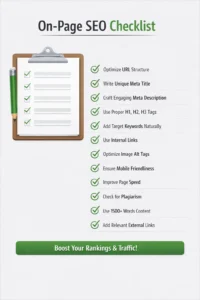
On Page SEO Checklist
Element |
What to Check |
|
URL |
Short, readable, keyword optimized |
|
Meta Title |
50–60 characters |
|
Meta Description |
150–160 characters |
|
H1 Tag |
Only one, keyword included |
| H2 & H3 |
Proper hierarchy |
|
Keyword Placement |
Natural, not stuffed |
|
Content Length |
1500+ words |
|
Internal Links |
3–5 relevant links |
|
Images |
Alt text added |
|
Mobile Friendly |
Responsive design |
| Page Speed |
Fast loading |
| Plagiarism |
100% unique |
This checklist ensures strong page-level optimization
Frequently Asked Questions (FAQ)
1. What is the ideal length for SEO content?
1500–2000 words work best for competitive topics.
2. How many keywords should I use?
Focus on one primary keyword and several related variations.
3. Does meta description affect ranking?
Not directly, but it improves click-through rate.
4. How important is internal linking?
Very important for SEO structure and crawlability.
5. Can affordable SEO services still deliver results?
Yes, if the strategy is strong and execution is correct.
6. What is enterprise SEO?
Enterprise SEO focuses on large websites with thousands of pages and advanced strategies.
Final Thoughts
On-Page SEO is the backbone of digital visibility. By optimizing URLs, meta tags, headings, keywords, internal links, and content structure, you can significantly improve your rankings.
Follow this structured approach and implement the checklist consistently to see long-term organic growth.